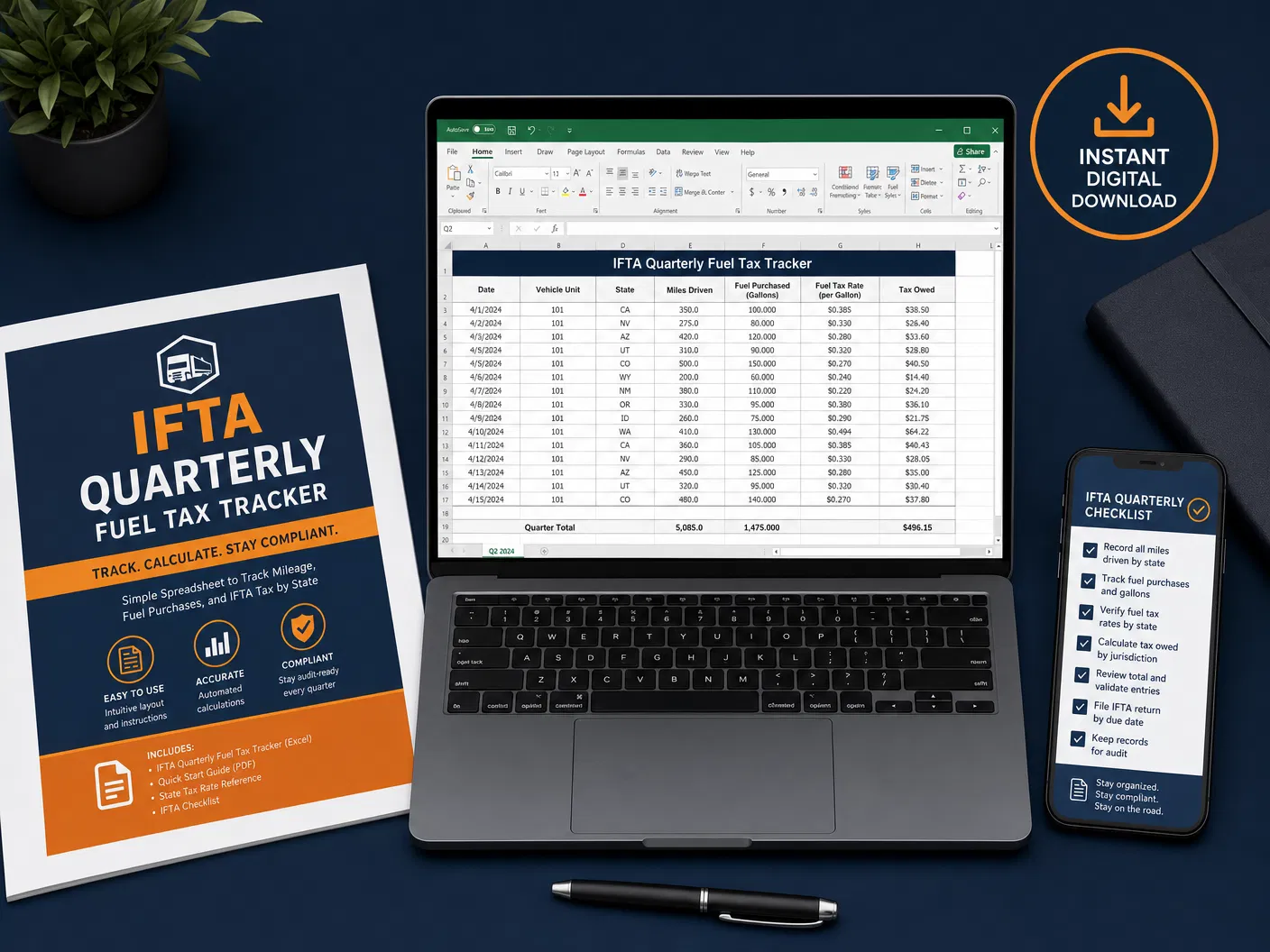
Stop dreading IFTA filing day. Track every mile, every gallon, and every jurisdiction automatically — so your quarterly return takes minutes, not hours.
Stop dreading IFTA filing day. The IFTA Quarterly Fuel Tax Tracker gives interstate carriers a simple, organized system to record every mile driven and every gallon purchased — by jurisdiction — so your quarterly fuel tax return is accurate, audit-ready, and done fast.
WHAT IS IFTA?
The International Fuel Tax Agreement (IFTA) simplifies fuel tax reporting for commercial motor vehicles operating in multiple U.S. states and Canadian provinces. Instead of filing separate fuel tax returns in every state you operate in, IFTA lets you file one quarterly return with your base jurisdiction. The base state then distributes the taxes to each jurisdiction based on your reported mileage.
WHO MUST FILE IFTA?
You are required to obtain an IFTA license if you operate a qualified motor vehicle that:
• Has two axles and a gross vehicle weight or registered gross vehicle weight exceeding 26,000 lbs, OR
• Has three or more axles regardless of weight, OR
• Is used in combination where the combined weight exceeds 26,000 lbs
AND the vehicle travels in two or more IFTA member jurisdictions.
QUARTERLY FILING DEADLINES:
• Q1 (Jan 1 – Mar 31): Due April 30
• Q2 (Apr 1 – Jun 30): Due July 31
• Q3 (Jul 1 – Sep 30): Due October 31
• Q4 (Oct 1 – Dec 31): Due January 31
RECORD-KEEPING REQUIREMENTS (4-YEAR RULE):
IFTA requires you to maintain records for a minimum of 4 years from the filing due date. Required records include: trip reports showing odometer readings at state line crossings, fuel purchase receipts with date/location/gallons/vehicle unit, and mileage summaries by jurisdiction per vehicle.
WHAT'S INSIDE THIS TRACKER:
• IFTA Quarterly Fuel Tax Tracker (XLSX) — Pre-built spreadsheet with tabs for each quarter. Tracks miles by state, fuel purchased by state, calculates net tax owed/refund per jurisdiction automatically.
• Per-Vehicle Trip Log Template (XLSX) — Daily mileage log with state-by-state entry fields, odometer readings, and fuel stop documentation.
• Fuel Purchase Receipt Log (XLSX) — Organized fuel receipt tracker with vendor, date, location, gallons, and cost per gallon.
• Annual IFTA Summary Dashboard (XLSX) — Year-at-a-glance view of all four quarters.
• IFTA Quick-Start Guide (PDF) — Plain-language explanation of IFTA, who must file, how to read your return, and what triggers an audit.
• State Fuel Tax Rate Reference Sheet (PDF) — Current-year reference guide for all IFTA member jurisdictions (note: rates change; verify with your base state before filing).
• Audit Preparation Checklist (PDF) — Exactly what auditors look for and how to organize your records.
TOP AUDIT TRIGGERS TO AVOID:
Missing trip reports | Fuel purchased doesn't match miles reported | Inconsistent odometer readings | Filing late | Bulk fuel not reported
IMPORTANT LEGAL NOTICE: This product is for organizational and operational guidance purposes only. It does not constitute legal, regulatory, or professional compliance advice. All content is 100% original work by SolveSuite Studio. Federal and state regulations change frequently — always verify current requirements with the appropriate regulatory authority (FMCSA, your state DMV, or a licensed transportation attorney). Use of this product does not guarantee regulatory compliance. Consult a qualified transportation compliance professional for your specific situation.
What You Get
Instant digital download after payment
Secure download link valid for 7 days
Up to 5 downloads per purchase
Re-access from your order history anytime
File: IFTA_Complete_Kit_SolveSuite.zip
100% Original Content
This product is independently created by SolveSuite Studio. No text has been copied from competitors, regulatory bodies, or third-party sources. All content is protected by copyright law.
Informational Use Only — Not Legal Advice
This product provides organizational tools and operational guidance. It does not constitute legal, regulatory, or professional compliance advice. Federal and state regulations change frequently — always verify current requirements with the appropriate regulatory authority (FMCSA, your state DMV, or a licensed transportation attorney).